Cone Penetration Tests NYC - Manhattan, The Boroughs, Nassau County, Suffolk County, Long Island, and New Jersey - Kagaoan Engineering
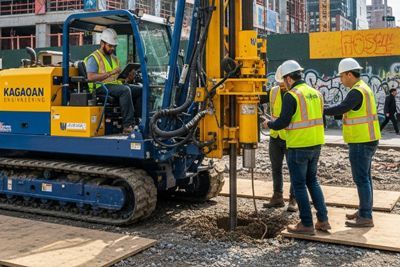
Cone Penetration Testing Consultants
The Cone Penetration Test (CPT) is one of the most precise and efficient methods for evaluating subsurface soil conditions before construction begins. By pushing a sensor‑equipped cone into the ground at a controlled rate, engineers capture continuous real‑time data on soil strength, stratigraphy, and behavior. This level of accuracy makes CPT an essential tool for designing safe, reliable foundations across a wide range of geotechnical projects.
Contact us for a free consultation.
What Makes the Cone Penetration Test (CPT) Essential?
The Cone Penetration Test is a geotechnical investigation method used to determine soil properties and assess subsurface conditions. It involves pushing a cone-shaped tip, mounted on a cylindrical probe, into the ground at a steady rate. CPT provides real-time data on soil composition, strength, and other key characteristics without extensive sampling or drilling. First developed in the 1930s, this method has become a global standard in soil testing due to its precision and efficiency.
The test is often used for projects that require crucial data on soil stratigraphy and bearing capacity. By measuring dynamic resistance, engineers gain reliable insights into soil behavior beneath the surface. Its ability to deliver continuous data sets sets it apart from other geotechnical testing techniques. CPT's precision minimizes human error, and real-time outputs save engineers both time and resources. Overall, the Cone Penetration Test is integral to ensuring the success and safety of foundational construction projects.
When The Cone Penetration Test Would Be Used
The Cone Penetration Test is commonly applied in a variety of soil-related engineering and geotechnical projects. It is often used when precise soil data is required quickly, primarily during the planning stages of construction projects. This method is particularly beneficial for evaluating soil stratification and identifying layered subsurface conditions. When assessing soil load-bearing capacity for foundation design, CPT is the tool of choice. It is also employed to mitigate risks in areas with loose or unstable soils by determining suitable foundation types and construction methods.
The CPT is critical when evaluating soft soil characteristics to properly design infrastructure, such as roads, bridges, or high-rise buildings. Coastal and waterfront projects often rely on CPT to analyze the behavior of sediment deposits under load, ensuring structural stability. It also plays a key role in assessing areas prone to liquefaction due to seismic activity. Engineers rely on testing when designing deep foundations such as piles or caissons.
Beyond construction, CPT contributes to environmental projects, such as evaluating contaminated sites to determine their suitability for supporting remediation structures. It is also useful when detailed soil resistance profiles are required before infrastructure expansion projects. Tailored CPT analyses can help engineers modify original plans for better alignment with soil conditions. With its unmatched ability to provide clear, actionable data, CPT is an indispensable component of groundwork engineering in all project phases.
Types of Cone Penetration Tests
Cone Penetration Tests come in several variations, each tailored to specific soil conditions or project requirements. Variations in CPT enable engineers to collect specific types of data to serve unique project needs better.
- Standard Cone Penetration Testing (Static CPT) - This is the most widely used method and involves pushing the cone through the soil at a constant rate, typically 2 cm per second. The test measures cone resistance and sleeve friction, providing data crucial for understanding soil stratigraphy. This method works well for general-purpose soil exploration and provides high accuracy in non-cohesive soils.
- Seismic Cone Penetration Testing (SCPT) - SCPT incorporates geophones within the cone to measure seismic wave velocities in soil. This variant is designed to evaluate soil stiffness and dynamic properties, making it ideal for earthquake-prone regions. Enhanced data from seismic CPTs enable engineers to assess liquefaction risk and design earthquake-resistant foundations.
- Piezo Cone Penetration Testing (CPTu) - Also called CPTu, this variant measures soil pore water pressure in addition to cone resistance and sleeve friction. It is particularly effective in saturated soils, providing valuable insights for designing drainage systems and assessing consolidation characteristics. Pore water pressure data generated by CPTu adds an extra layer of precision for projects in wetlands or flood-prone areas.
- Cone Penetration with Soil Sampling (CPT-S) - This type allows for simultaneous penetration testing and sample extraction. Engineers can analyze physical soil samples in a lab and correlate the data with field measurements. It is most commonly used for projects that require both in-situ data and physical evidence of soil quality, such as landfill construction.
Candidates for the Cone Penetration Test
A variety of individuals or organizations may benefit greatly from deploying the Cone Penetration Test for their projects. Engineers and project managers overseeing large-scale infrastructure developments often rely on CPT to better understand subsurface conditions. It provides reliable data for foundation design, thereby reducing the risk of structural failure.
Private landowners undertaking residential or commercial construction can benefit from CPT by ensuring their soil has adequate load-bearing capacity. This is particularly crucial for multi-story structures where weight distribution is a key factor. Environmental consultants also use the test to evaluate subsurface conditions in areas undergoing restoration. CPT's ability to assess soil contamination supports effective remediation planning.
Government agencies often use CPT during the planning phases of public infrastructure projects such as highways, bridges, and ports. It supports cost estimation and mitigates unexpected soil-related issues during construction. Coastal engineers specializing in seawall and levee projects rely on CPT to understand how sediments interact with water pressure over time.
The test is also invaluable to geotechnical consultants involved in renewable energy projects, such as wind turbine installation. Heavy machinery manufacturers may even request CPT analyses to validate the soil's capacity to support the equipment's weight. Lastly, developers of waterfront properties utilize CPT to address soil variability in sediment-rich zones.
What Can Happen if the Cone Penetration Test is Not Completed
Neglecting to conduct the Cone Penetration Test can introduce a host of challenges and risks to any construction or engineering project. First and foremost, without accurate soil properties, foundational designs may lack the necessary stability, leading to premature structural problems. Projects may experience cost overruns or delays when unidentified soil conditions pose unforeseen barriers.
Failing to perform CPT increases the likelihood of safety incidents due to unstable ground. Collapsing excavations or misaligned foundations can cause severe repercussions to timelines and budgets. Additionally, areas prone to liquefaction or seismic activity could suffer catastrophic failures if unaddressed before construction begins. Design modifications after construction starts can become prohibitively expensive without preemptive data.
Skipping CPT can also result in legal liabilities, harming the reputational standing of project stakeholders. Furthermore, the environmental consequences of soil disturbances magnify when soil behavior is not clearly evaluated beforehand. Overall, skipping a CPT can unravel the success, safety, and reliability of any construction effort, making thorough testing an indispensable step in project planning.
Why Clients Choose Kagaoan Engineering
Clients repeatedly trust Kagaoan Engineering for its expertise and commitment to high-quality service. The firm stands out for its proven track record of delivering innovative solutions to complex geotechnical challenges. Kagaoan Engineering employs state-of-the-art equipment to conduct precision-driven Cone Penetration Tests, ensuring reliable, actionable data for every project.
The team boasts extensive experience in adapting CPT techniques to varied geological conditions, enabling them to offer tailored services. With a customer-centric approach, Kagaoan Engineering prioritizes time-efficient solutions without compromising quality. Their engineers regularly collaborate with clients to address specific project needs, ensuring optimal outcomes.
Kagaoan Engineering has developed an exceptional rapport within the construction industry by consistently meeting deadlines and budgets with integrity. Their deep understanding of local geologic conditions in NYC and the surrounding areas sets them apart as regional experts. The company's ability to integrate CPT with other geotechnical services makes it a one-stop solution for clients.
By choosing Kagaoan Engineering, clients gain access to industry-leading knowledge, advanced technology, and a commitment to excellence. Every project is treated with precision and professionalism, making Kagaoan Engineering a trusted partner across the board.
Summary
The Cone Penetration Test is a vital tool for any project manager, engineer, or stakeholder looking to ensure the integrity of subsurface conditions. With its diverse testing capabilities, from standard CPT to piezo- or seismic-variant testing, it provides reliable, cost-efficient data for informed decision-making. Without a proper CPT, projects face unnecessary risks, delays, and financial burdens.
Kagaoan Engineering has built a reputation for delivering high-quality CPT services tailored to meet individual project demands. Their expertise in advanced geotechnical methods enables precision unmatched elsewhere. Don't jeopardize your future project by overlooking essential geotechnical evaluations.
Contact Kagaoan Engineering today for a consultation and discover how their Cone Penetration Test services can provide you with confidence and peace of mind. With their dedicated team of engineers, your project goals are not just achievable but highly optimized. Schedule your consultation now to ensure a strong foundation for tomorrow.